
 SEARCH
 LIST YOUR PROPERTY
Are you wondering if you are still allowed to share your apartment after the recent political unrest in Switzerland? At Roomlala, we receive questions every day from tenants and hosts who are understandably concerned by rumours of stricter laws. Rest assured: subletting in Switzerland in 2026 remains a perfectly legal, regulated, and secure practice. Whether you want to rent out a spare room to help make ends meet or offer a furnished room to a student passing through, home sharing still has a bright future.
With the recent debates surrounding Swiss housing law, it is normal to feel lost. Tenancy law has been the subject of lively discussions, leading many tenants to wonder whether they can still host someone in full compliance. The good news is that the current legal framework still protects your right to sublet, provided you follow a few common-sense rules and maintain transparency.
Read also: Student housing Canada 2026: What is the impact of the new cap on room rentals?, Student housing shortage in Switzerland: Homestay, a vital solution for 2026 and Student accommodation EPC 2026: Everything you need to know about the new rental rules in Belgium
In this comprehensive article, we will decode the subtleties of subletting law in 2026 for you. We will explain how to obtain your landlord's consent, how to set a fair rent without falling into abuse, and what your responsibilities are. Get ready to rent out your room with peace of mind and in full compliance with the law!
The legal framework for subletting in Switzerland in 2026: What has (really) changed
The rejection of the two-year limit (Vote of November 2024)
To fully understand the situation in 2026, we need to take a quick step back. At the end of 2024, a proposed revision of the Code of Obligations sent shockwaves through the rental world. This project aimed to drastically restrict subletting, notably by imposing an arbitrary two-year duration limit. At Roomlala, we followed these debates very closely, as they directly threatened the sharing economy and housing flexibility.
Fortunately for tenants, the Swiss people have had their say. During the federal vote on 24 November 2024, this restrictive amendment was rejected with 51.58% against. Tenant defence associations, particularly ASLOCA regarding subletting, played a crucial role in informing the public about the dangers of this law. This historic vote has helped maintain a fair balance between the rights of landlords and those of tenants.
Today, in 2026, long-term subletting remains fully legal. There is no time limit imposed by federal law. If you are going abroad for work for three years, or if you wish to host a student for the duration of their bachelor's degree, you have every right to do so, provided you intend to return to the property or if the partial subletting (a room) falls within the duration of your own lease.
Article 262 of the Code of Obligations: Still your best ally
Since the revision was rejected, the illustrious Article 262 of the Code of Obligations (CO) remains the absolute standard regarding subletting tenancy law. This article clearly states that the tenant has the right to sublet all or part of their home. It is a fundamental right that cannot be taken away from you by a simple clause in your tenancy agreement.
However, this right is not unconditional. Article 262 specifies that subletting is subject to the consent of the landlord (the owner or the property management agency). This point is crucial: you cannot sublet in secret. At Roomlala, we always encourage total transparency. A relationship of trust with your landlord is the key to a successful and serene subletting experience.
It is important to note that many standard tenancy agreements today still contain a clause that, in principle, prohibits subletting. Legally, in Switzerland, such a general prohibition clause is considered void. Your landlord cannot absolutely forbid you from subletting. They must examine each request on a case-by-case basis, according to very strict criteria defined by law.
How to rent your room legally and obtain the landlord's consent?
The golden rule: prior written consent
To rent your room legally, the first essential step is to obtain your landlord's agreement before your subtenant even arrives. Subletting without asking for this authorisation exposes you to major risks. Indeed, a landlord who discovers an undeclared sublet has the right to demand the immediate termination of your own lease due to a breach of trust, leaving you without a home.
At Roomlala, we strongly advise you to always submit your request in writing, ideally by registered post. Your request must be transparent and contain all the information necessary for the landlord to make their decision. Here is what you must provide them with:
- The full identity of the subtenant (surname, first name, copy of an identity document).
- Financial conditions (the amount of the sublet rent and utility costs).
- The planned duration of the sublet (start and end dates, or a mention of an indefinite period).
- The intended use of the premises (exclusively for residential purposes).
Once the request is sent, wait for the written response from your management agency or landlord. Never settle for a simple verbal agreement over the phone, as in the event of a dispute, you would have no evidence to provide. Written consent is your best insurance for sleeping soundly.
The three legitimate grounds for refusal by the landlord
As mentioned previously, your landlord cannot refuse your subletting request on a mere whim. Swiss housing law is very clear on this: refusal is only valid for three strict and exhaustive reasons. If your situation does not fall into any of these three categories, the landlord is obliged to accept.
The first ground for refusal is the tenant's refusal to disclose the terms of the subletting. If you hide the name of your subtenant or the amount of rent you are going to charge, the landlord has the right to say no. Transparency is therefore your best ally.
The second ground concerns abusive conditions. The landlord will ensure that you are not making a profit at their expense (we will return to this in detail in the next section). If you rent your apartment for 1500 CHF and you sublet a room for 1200 CHF, the landlord will categorically refuse due to abusive overpricing.
The third ground is major inconvenience for the landlord. This criterion is assessed on a case-by-case basis. For example, if you sublet a 20m2 studio to a family of four, the landlord will invoke overcrowding of the premises. Likewise, if the subtenant has notoriously problematic behaviour or if they use a residential room to set up a noisy workshop, the refusal will be justified.
Avoiding financial pitfalls: The 'zero profit' rule
How to calculate a fair rent for your subtenant?
One of the pillars of subletting in Switzerland in 2026 is the strict prohibition on making a financial profit. The legislator considers that the primary tenant should not get rich thanks to a property that does not belong to them. The rent you ask your subtenant for must therefore cover only their actual costs, without any profit margin.
To calculate a fair rent, you must base it on the primary rent you pay, including charges, and divide it proportionally. The most common method accepted by management agencies is the calculation per square metre. You must take into account the surface area of the room rented exclusively, as well as a share of the common areas (kitchen, bathroom, living room).
Let's take a concrete example: you rent a 100m2 apartment for a total rent of 2000 CHF per month. You decide to sublet a 20m2 room, and the subtenant has access to 40m2 of common areas that they share with you (which is 20m2 equivalent for them). The total surface area allocated to them is therefore 40m2. The fair rent would be (2000 / 100) x 40 = 800 CHF per month. You can add half of the electricity and internet bills to this.
The exception for furnished rooms: the surcharge for depreciation
There is a legal exception to the strict rule of proportional rent. If you offer a furnished room on Roomlala, you are entitled to apply a slight surcharge to the base rent. This surcharge is not considered a profit, but a financial compensation for the wear and tear of your own furniture (bed, wardrobe, desk, television, etc.).
In Switzerland, jurisprudence and associations such as ASLOCA agree that a surcharge for furniture depreciation is acceptable if it is between 15% and 20% maximum of the base rent of the room. Going beyond this percentage would risk pushing your contract into the category of abusive conditions, justifying a refusal by the landlord.
For example, if the proportional rent for an unfurnished room is calculated at 500 CHF, you can legally ask your subtenant for a furnished rent between 575 CHF and 600 CHF. At Roomlala, we recommend that you keep the purchase invoices for your furniture. In the event of an inspection by the agency, you will thus be able to easily justify this surcharge and prove your good faith.
Responsibilities and best practices for serene cohabitation
The primary tenant remains the sole guarantor
It is fundamental to understand that subletting does not create any direct legal link between your subtenant and your landlord. As the primary tenant, you remain the sole legal and financial representative towards the landlord. This is what is called joint and exclusive liability.
In concrete terms, this means that if your subtenant does not pay their rent at the end of the month, you are still required to pay the full primary rent to your agency. The landlord will not turn against the subtenant, they will turn against you. Similarly, if the subtenant causes damage to the apartment (stain on the parquet, broken window), it is your security deposit that will be engaged at the end of the lease.
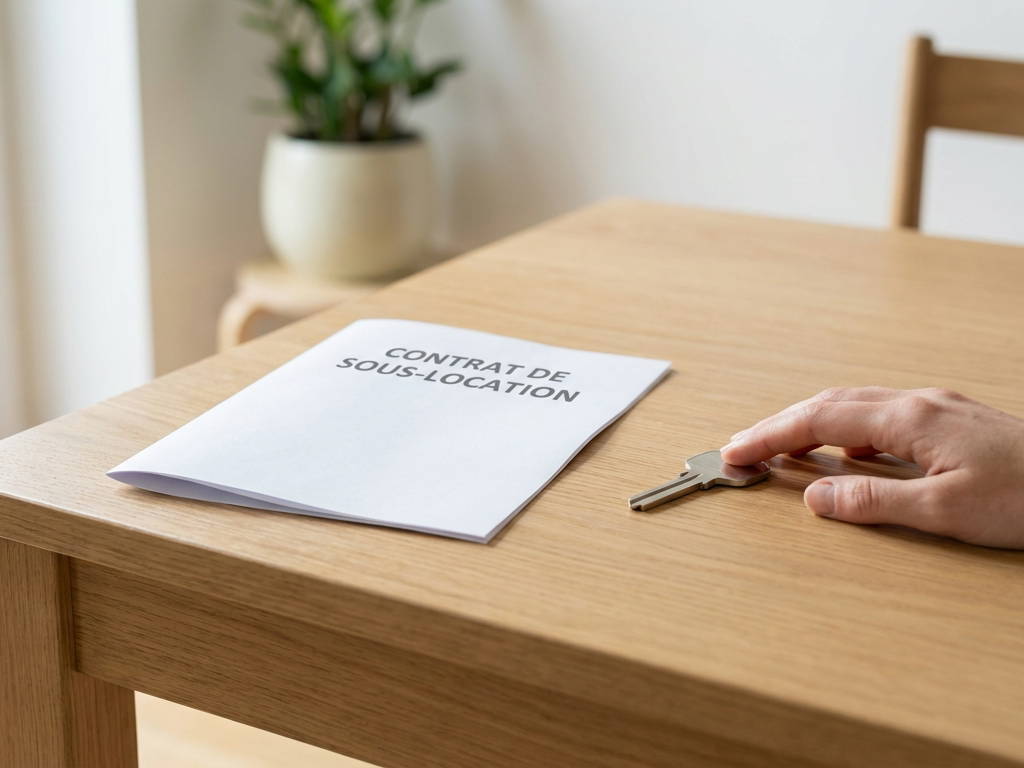
To protect yourself, we advise you to demand proof of private civil liability (RC) insurance valid in Switzerland from your subtenant, as well as a deposit equivalent to one or two months' rent. Always draw up a written and detailed subletting contract, and carry out a thorough inventory check at the start and end. On Roomlala, our platform facilitates these steps to offer you a secure framework.
Focus on the Canton of Vaud: The new RULV of July 2026
While federal law sets out the broad outlines, it is important to remain attentive to cantonal specificities. For example, in the Canton of Vaud, new Vaudois Rental Rules and Practices (RULV) came into force on 1 July 2026. These new guidelines further clarify and regulate the practice of subletting at the local level.
The 2026 RULV insist heavily on the obligation to formalise exchanges. They reiterate that the landlord's written consent is a mandatory step and that agencies have a regulated response time (generally 30 days) to validate or refuse the request, provided that the file submitted by the tenant is complete.
These cantonal rules also specify the calculation methods for recharging heating and hot water costs, in order to avoid frequent disputes at the end of the year. If you reside in the Canton of Vaud or in another canton with specific parity rules (such as Geneva), take the time to consult local official documents or contact your cantonal section of ASLOCA to ensure total compliance.
In conclusion, subletting in Switzerland in 2026 remains a fantastic opportunity to monetise your spare space or find flexible housing, provided you play the transparency game. By respecting tenancy law, obtaining your landlord's written agreement, and applying a fair rent, you protect yourself from any legal unpleasantness. At Roomlala, we are proud to support you every day to make cohabitation a human, secure, and 100% legal experience!

There are no comments yet.
Leave a comment
You must be logged in to post a comment.