
 SEARCH
 LIST YOUR PROPERTY
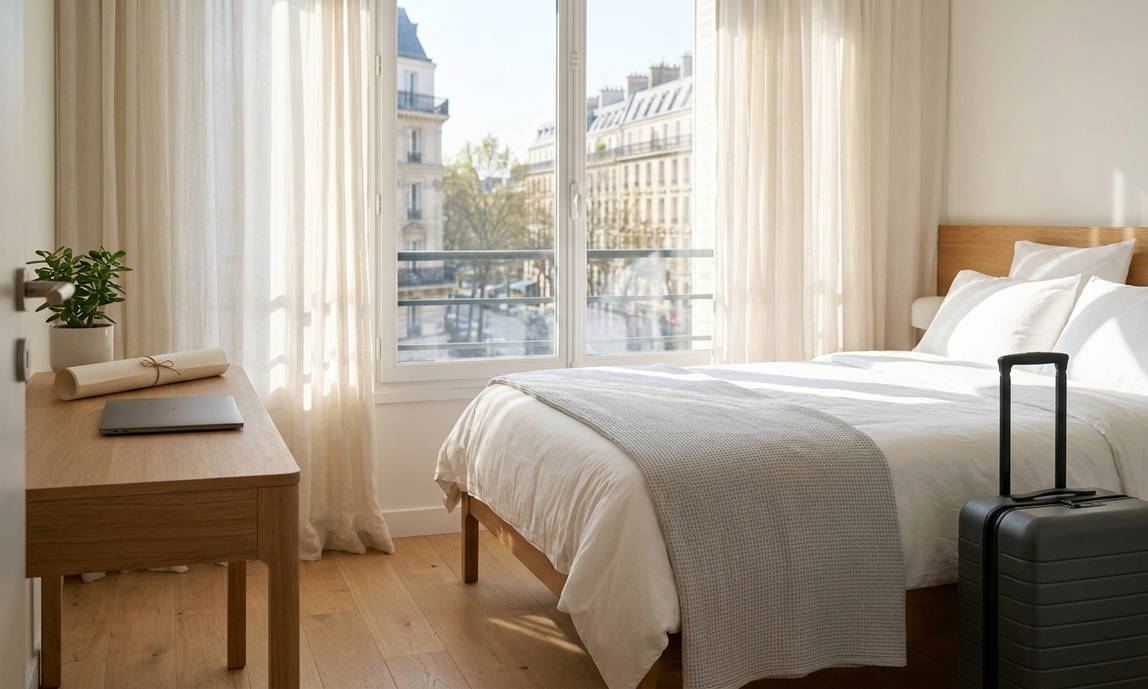
With the September 2026 term approaching, finding a place to stay has become a top priority for thousands of people across France. Whether starting a new university course, beginning a final-year internship, or undertaking a temporary professional mission, the need for flexibility has never been greater. On the host side, the fear of unpaid rent and the desire to remain in control of their property sometimes discourage people from renting. This is where the 2026 mobility lease comes in. This contract, specifically designed for temporary stays, provides a reassuring and extremely flexible legal framework. At Roomlala, we are convinced that this arrangement is key to a peaceful and mutually beneficial rental experience. In this article, we take a deep dive into how this contract works, its recent legal updates, its tax benefits, and why it represents the ideal solution for renting out your room in a homestay with complete peace of mind.
What is the 2026 mobility lease and who is it for?
A contract designed for transitions
The mobility lease is a short-term furnished rental contract that deviates from the standard rules of a one-year furnished lease. Created by the ELAN law, it was designed to meet a societal reality: the increasing mobility of students and workers. Unlike a standard 9-month student lease or a 12-month furnished lease, the 2026 mobility lease allows for the duration of the rental to be set freely between 1 and 10 months. This flexibility is a major advantage for hosts who wish, for example, to reclaim their spare room for the summer or to host family during the festive season.
Read also: Student housing crisis in Belgium: Why a homestay is the solution for the start of the 2026 academic year, New subletting rules in Switzerland: What tenants need to know in 2026 and 2026 Rental Price Crisis: Why homestays are saving the start of the academic year for Italian students
It is important to note that this contract applies exclusively to furnished accommodation. At Roomlala, we often remind our hosts that the room being rented must comply with a strict list of mandatory equipment (bedding with a duvet, shutters or curtains, storage, lighting, cleaning equipment, etc.). The goal is simple: the tenant should be able to drop off their suitcases and live comfortably from the first day, without having to invest in any furniture. It is this turnkey dimension that makes this arrangement so successful.
Concrete example: Martine has a large, free room in her Bordeaux flat from September to March, as her son is going on Erasmus. Thanks to the mobility lease, she can rent this room for exactly 7 months. At the end of this period, the contract ends automatically, without her having to provide a complex reason for termination, allowing her to get the room back just in time for her son's return.
Profiles eligible for the French temporary rental contract
One of the fundamental features of the mobility lease is that it is not open to everyone. To sign this French temporary rental contract, the tenant must be in a situation of mobility at the time the lease takes effect. The law is very clear on eligible profiles: students (in higher education), apprentices, interns, people in professional training, young people on voluntary engagements (civic service), as well as employees on professional transfers or temporary assignments.
As a host, it is your responsibility to request and keep proof of this situation (student card, internship agreement, employer's certificate for a mission, etc.). Without this document, the contract could be reclassified as a standard furnished lease, causing you to lose all the advantages linked to short-term status. At Roomlala, we facilitate this process by allowing tenants to upload their profile documents, giving you immediate visibility into their eligibility.
Concrete example: Lucas, an engineer from Paris, is sent on a temporary mission to Lyon for 4 months. He is looking for a student room rental or a room for a young professional. He provides his future Lyon-based host with a certificate from his company confirming the dates of his mission. The host can then have him sign a 4-month mobility lease in full compliance with the law.
The rules of the mobility lease: Duration, notice periods, and new legal changes
A flexibility of 1 to 10 months (and the 18-month exception)
The golden rule of the mobility lease is its duration: it must be between 1 and 10 months maximum. This duration is set by mutual agreement at the time of signing. An interesting feature of this contract is that it is neither renewable nor tacitly extendable beyond the 10-month limit. If you have signed a 4-month lease, you can extend it by an additional 2 or 3 months via an addendum, but the total cumulative duration can never exceed 10 months. This strict rule protects the host against a tenant settling in permanently when the host wishes to recover their property.
However, the year 2026 brings a major legislative change that we wish to highlight. Law no. 2025-1129 of 26 November 2025 introduced a highly anticipated exception: it is now possible to extend the maximum duration of the mobility lease to 18 months, but only for accommodation located in employment-oriented residences (residences managed specifically for mobile workers). Although this exception applies to specific structures, it demonstrates the legislator's desire to adapt the law to the reality of the job market.
Concrete example: You rent a room to a student for 6 months. At the end of this period, she gets an internship in the same city and wishes to stay for 3 more months. You can perfectly well sign an addendum to extend the lease up to a total of 9 months, thus remaining within the 10-month legal limit.
Notice periods and departure conditions: who decides?
One of the key principles of the mobility lease rules is the asymmetry of departure conditions, designed to protect the tenant's stability while offering flexibility. For the tenant, the freedom is total. They can decide to leave the accommodation at any time, without having to provide a specific reason. The only constraint is to respect a reduced notice period of one month. This notice period starts from the moment the host receives the registered letter with acknowledgement of receipt, the bailiff's document, or it is handed over in person against a signature.
For the host, the rule is the exact opposite. You are strictly forbidden from giving your tenant notice before the end date specified in the contract, even if you have an urgent need to get the room back. The landlord is obliged to respect their commitment until the set end date. Once the end date is reached, the contract ends automatically, without you needing to send a notice letter or respect a notice period. The tenant simply has to return the keys.
Concrete example: A student signs an 8-month lease. After 3 months, they decide to drop out of their studies and move back in with their parents. They send you their one-month notice. You cannot force them to pay for the remaining 4 months. On the other hand, if you are the one who wants to recover the room after 3 months, you cannot force them to leave before the end of the initial 8 months.
Hosts: Financial security and protection without a security deposit
The strict prohibition of the security deposit
This is often the point that scares novice hosts the most: under a mobility lease, the law strictly prohibits demanding a security deposit (commonly known as a "caution") from the tenant. This measure was taken to facilitate access to housing for people in mobility, who do not always have the necessary cash to pay one or two months' rent in advance, plus the first month and set-up costs. Any clause in the contract providing for a security deposit would be considered null and void by the courts.
At Roomlala, we understand that this prohibition may cause concern. How can one protect against damage to furniture or unpaid rent if you have no money in reserve? This is a legitimate question. However, the legislator has provided a powerful and completely free alternative to secure hosts, making the security deposit obsolete for this type of temporary rental.
Concrete example: A host asks for a 500-euro security deposit cheque from their tenant on a mobility lease to ensure their room will not be damaged. The tenant, knowing their rights, refuses. If they accepted and a dispute arose, a judge would condemn the host for illegal practice. It is therefore crucial to respect this prohibition to remain within the law.
The Visale guarantee: Your shield against unpaid rent
To compensate for the absence of a security deposit, the State, via Action Logement, has set up the Visale guarantee. This system is the host's best ally in the context of a mobility lease. It is a rental guarantee granted free of charge to the tenant, which covers the payment of rent and utility charges in the event of unpaid rent, as well as the cost of repairs in the event of rental damage. It is an extremely robust cover that protects the landlord far more effectively than a single month of deposit.
To benefit from it, the process is simple but must be completed before the lease is signed. The tenant must apply on the Visale website and obtain a certified visa. The host then creates their own account on the same site, enters the tenant's visa number, and validates the guarantee contract. In the event of a problem, Action Logement reimburses you quickly and then takes charge of recovering the debt from the tenant. At Roomlala, we strongly encourage all our hosts to require the Visale visa from their tenants.
- Coverage of unpaid rent: Up to 36 months of unpaid rent covered for the entire duration of the lease.
- Coverage of damages: Coverage up to 2 months of rent and charges for repair costs.
- Totally free: Neither the tenant nor the host pays any fees for this service.
- Simplicity: All procedures are carried out online in a paperless and fast manner.
Points of legal vigilance for the start of the 2026 academic year: EPC and reclassification
The 2026 EPC constraints to be strictly respected
Since the implementation of the Climate and Resilience Law, the rental real estate market has undergone profound changes. At Roomlala, we want to warn our hosts about a crucial deadline: in 2026, the rules are becoming considerably stricter. As the mobility lease is subject to the same energy efficiency criteria as a standard rental, it is now strictly forbidden to sign a lease for accommodation classified as G on the Energy Performance Certificate (EPC/DPE). This measure aims to eradicate energy-inefficient housing and guarantee minimal comfort for tenants, especially during the winter months.
If you own a room in a property classified as F, rest assured: you have a grace period. The rental of these properties remains authorised until 2028. However, we strongly advise you to anticipate insulation or heating work now. In the event of non-compliance with this prohibition for a G-rated property, the penalties can be severe. The tenant has the right to take the matter to court to demand that work be carried out to bring the property up to standard at your expense, or to obtain a significant reduction or even a total suspension of the rent.
Concrete example: Valérie, a host in Lille, had been renting out a small G-rated attic room. For the start of the 2026 academic year, she can no longer offer this property under a mobility lease. She took advantage of the first half of the year to install double glazing and insulate the walls, moving her EPC into category E. She can now rent out her room in full compliance on Roomlala, even justifying a more attractive rent thanks to the new thermal comfort.
The risk of reclassification as a standard furnished lease
One of the most common traps hosts fall into is the legal reclassification of the contract. The mobility lease is a strict framework. If you do not meet its conditions, the courts will automatically consider that you have signed a standard one-year furnished lease (or 9 months for a student), with all the constraints that entails (inability to recover the accommodation before 1 year, 3-month notice period for the landlord, etc.). The first reason for reclassification concerns the duration. If your tenant stays in the premises after the 10th month and you accept the payment of an 11th month of rent without saying anything, the lease automatically shifts to a standard furnished rental.
The second reason for reclassification concerns the furnishings. If the room you are renting does not include all the mandatory items set by the 2015 decree (for example, if there are no hobs in the shared kitchen or blackout curtains in the room), the tenant can request reclassification as an unfurnished 3-year lease! It is therefore essential to carry out a meticulous inventory and a detailed check-in report at the beginning.
Concrete example: A host agrees that their tenant, whose 10-month mobility lease ends on 30 June, can stay until 15 July to finish their final exams, and they accept half a month's rent. Without knowing it, they have just transformed the contract into a standard furnished lease. The tenant is now entitled to stay for a full year if they wish. To avoid this, they would have needed to sign a new separate contract, if the law allowed it, or insist on them leaving on the agreed date.
Why choose the mobility lease for your student room rental on Roomlala?
Simplified management, 100% online
At Roomlala, we are committed to simplifying our hosts' lives. Renting out a room to a student or young professional can sometimes seem administratively tedious. By opting for the mobility lease, you are choosing the lightest contract best suited to renting rooms in a homestay. No management of a security deposit to collect and then return, no complicated calculations for deductions at the end of the stay. The relationship with the tenant is based on trust and secured by the Visale guarantee.
Furthermore, thanks to our platform, you can easily find verified profiles that perfectly match the eligibility criteria for the mobility lease. International students looking for a base for a semester, interns in search of a comfortable room... You have access to qualified demand. We also provide you with contract templates updated with the latest 2026 regulations, allowing you to finalise your rental in just a few clicks, without needing to call a lawyer.
Concrete example: Jean-Marc offers a room in his house near Nantes. Before, he hesitated to rent out of fear of committing for the long term. Today, he uses Roomlala to find interns for periods of 3 to 6 months. He generates his mobility leases directly, verifies internship certificates online, and enjoys the presence of dynamic young people without ever feeling stuck in his own home.
Advantageous taxation for furnished rental hosts
Finally, renting a room via a mobility lease allows you to benefit from the very advantageous status of Non-Professional Furnished Lessor (LMNP in France). The income generated from renting your room is not considered as standard property income but falls under the category of Industrial and Commercial Profits (BIC). This tax regime is particularly lenient in France.
If your annual rental income does not exceed a certain ceiling (generally 77,700 euros for standard furnished rentals), you can opt for the micro-BIC regime. This entitles you to a flat-rate allowance of 50% on your rental income. In other words, you will only be taxed on half of the rent received! If your actual expenses (depreciation of the property, work, loan interest) are higher than this allowance, you can opt for the actual regime, which often allows you to reduce your tax to zero for several years. It is an excellent way to make an unused room profitable while optimising your taxes.
Concrete example: By renting out their room for 400 euros per month for 10 months on a mobility lease, a Roomlala host receives 4,000 euros for the year. Under the micro-BIC regime, they will only declare 2,000 euros to the tax authorities. It is a particularly attractive net supplementary income to deal with inflation or to finance personal projects as the start of the new academic year approaches.


There are no comments yet.
Leave a comment
You must be logged in to post a comment.