
 SEARCH
 LIST YOUR PROPERTY

It is the end of 2026, and the rental property landscape in Belgium continues to evolve, particularly in the north of the country. If you are a host of a shared housing property or a tenant, you are certainly asking yourself questions about the Flanders rent indexation 2026. After years marked by the energy crisis and emergency measures, legislation has stabilised, but it has left behind sometimes complex calculation mechanisms. At Roomlala, we know that managing a rental or signing a lease can be a source of stress. That is why we have broken down the latest rules in force for you.
Flanders has firmly linked rent trends to the energy performance of buildings. Gone are the days when one could index a rent without worrying about the building's insulation! Today, the EPC certificate shared housing (Energieprestatiecertificaat, the equivalent of the energy performance certificate) is at the heart of the landlord-tenant relationship. Whether you are a host keen to be compliant or a housemate wanting to check that their rent is fair, this article guides you step-by-step through the legal obligations and rights of everyone at the end of 2026.
Read also: 2026 rent indexation in Brussels: EPC and shared housing rules, Rental guarantee in Flanders 2026: The new rules for renting a room long-term and Canada 2026 rental law: Why long-term room rentals are becoming essential over Airbnb
Understanding rent indexation in Flanders in 2026
Since the end of 2023, and this rule is still strictly in force at the end of 2026, the total freeze on rent indexation for energy-inefficient properties in Flanders has been lifted. For a one-year period (from October 2022 to October 2023), the Flemish government had banned or limited indexation to protect tenants from soaring energy prices. Today, the situation is different: all rents can be indexed again, regardless of the housing energy label.
However, this lifting of the freeze does not mean a return to the total freedom of before the crisis. To protect tenants from a brutal catch-up (where landlords could have applied the inflation accumulated during the freeze period all at once), the legislator has put in place very strict safeguards. These rental energy rules aim to smooth out the increase and encourage landlords to renovate their properties.
At Roomlala, we find that many of our users are still confused by these directives. It is essential to understand that the right to indexation is no longer a blind automation: it is now conditioned by energy transparency and compliance with the administrative procedures of the Flanders rental law.
The central role of the EPC certificate in shared housing
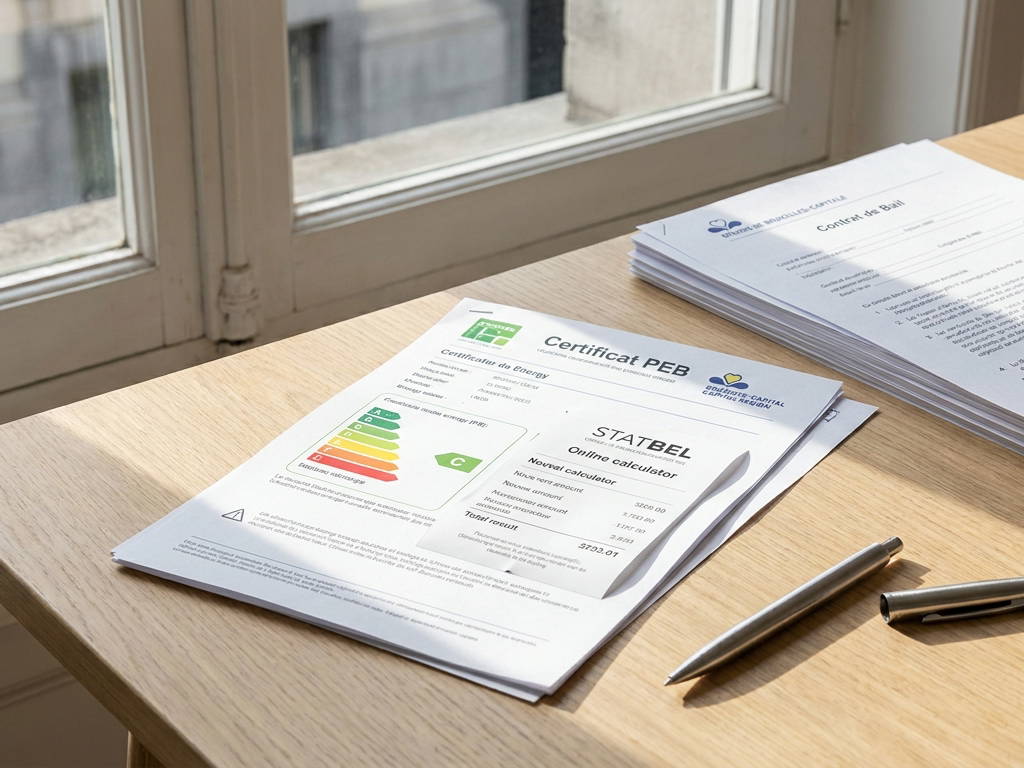
The EPC certificate (Energieprestatiecertificaat) has become the cornerstone of renting in Flanders. This document assesses the energy performance of your housing on a scale ranging from A+ (very energy-efficient) to F (very energy-intensive). In the context of shared housing, providing this certificate is not a simple administrative formality, it is a strict legal obligation.
To be able to index a rent in 2026, the landlord must have provided a copy of a valid EPC certificate to the tenants. If this document is missing, the law is uncompromising: the landlord will be heavily penalised in their indexation calculation. We advise you to always attach this document to the lease upon signing to avoid any subsequent dispute.
Use case: Imagine that you rent a large house in Antwerp to four young professionals. If you lose your EPC certificate or if it has expired (they are valid for 10 years), you will not be able to apply a normal indexation. You will be forced to apply the lowest rate, as if your house were classified as F, which represents a significant loss of earnings over a year.
Prerequisites for indexing a rent
In addition to the EPC certificate, rent indexation in Flanders requires compliance with several formal conditions. First of all, it is imperative that the rental contract is a written lease. Verbal agreements, although increasingly rare, do not allow for a legal indexation to be claimed.
Secondly, the lease must be duly registered with the competent registration office (FPS Finance). Registration is free for residential leases and must be completed within two months of signing. At Roomlala, we often remind our hosts that the absence of registration deprives the landlord of their right to indexation, while allowing the tenant to leave the premises without notice.
Finally, indexation only happens once a year, at the earliest on the anniversary date of the lease taking effect. It is based on the health index, which excludes certain products like tobacco and fuel, thereby ensuring a more measured evolution of housing costs.
The correction factor mechanism (Leases from before October 2022)
This is where Flemish legislation becomes particularly technical. To prevent landlords of poorly insulated properties from catching up on the indexation lost during the 2022-2023 freeze, Flanders introduced a "correction factor". This mathematical mechanism applies specifically to primary residence leases that came into force before 1 October 2022.
If you signed a Belgium shared housing lease (Flemish side) after this fateful date of 1 October 2022, this correction factor does not concern you. For these more recent contracts, indexation is done in the classic way, even if the property has a poor EPC label. The legislator considers that for recent leases, the initial price was set taking the energy crisis into account.
It is therefore essential to check the effective date of your contract. We recommend that all our users carefully re-read the first page of their lease to ensure they understand the applicable calculation formula.
How is this correction applied according to labels?
The correction factor applies gradually according to the energy performance of the building. If your property benefits from an EPC label of A, B or C, congratulations: you are not subject to any correction factor. You can apply the standard 100% indexation, thus rewarding your renovation efforts.
On the other hand, for properties with an EPC label of D, indexation is capped at 50% of the inflation calculated over the freeze period, then adjusted. For properties with an E or F label (thermal sieves), the correction factor is even more severe, drastically limiting the rent increase to protect the purchasing power of the housemates.
Point of vigilance: The penalty for the absence of an EPC is heavy. Renting out shared housing without a valid EPC certificate forces the landlord to apply the most penalising correction factor, i.e., the one equivalent to labels E and F. So, never neglect this process!
Concrete example and calculation tools
Calculations involving the correction factor are complex because they require the use of health indices from different years (2022, 2023, and the current year). An error can easily happen, which can deteriorate the relationship of trust between the landlord and their tenants.
Concrete example: Let us take a shared housing property in Ghent rented for €1,200 since January 2021 (before Oct 2022). The EPC label is E. On the anniversary date in January 2026, the landlord cannot simply multiply €1,200 by the new health index divided by the base index. They must apply the formula including the Flemish correction factor, which will result in an increase significantly lower than that of a property classified as A.
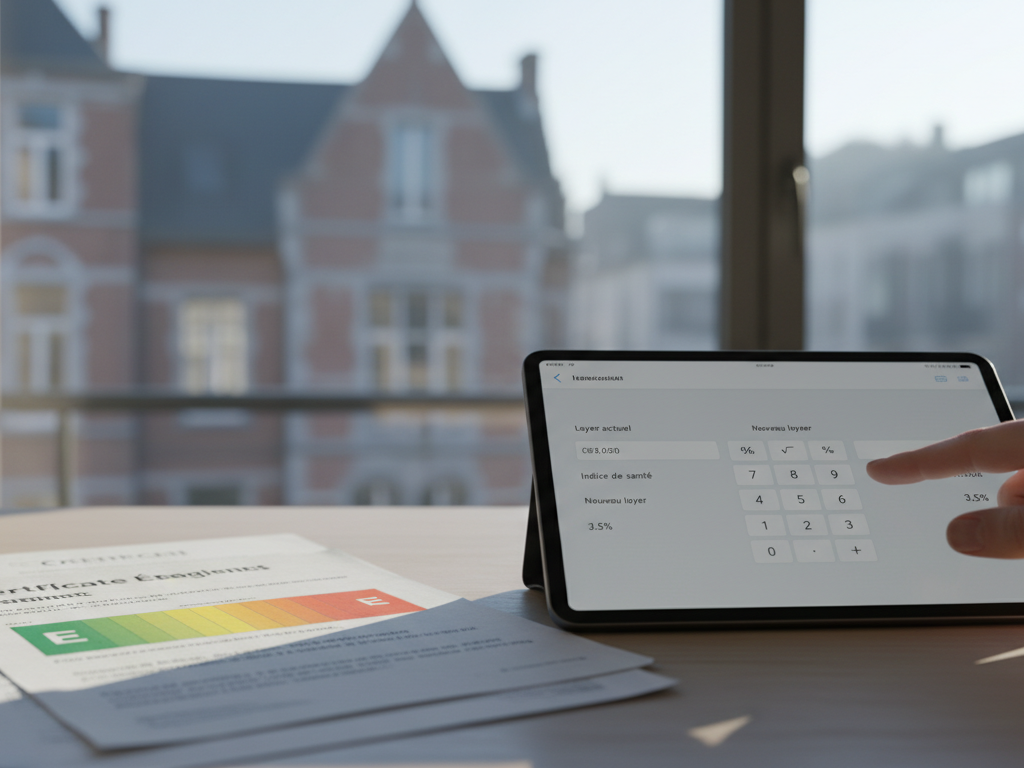
To avoid any error, we strongly advise you to use the official rent calculator from Statbel (the Belgian statistical office). This free online tool automatically integrates the Flemish regional corrections. You just need to enter the signing date, the base rent, the region, and the EPC label to obtain the exact and legal amount down to the cent.
Primary residence shared housing vs student accommodation: What are the differences?
In Flanders, the legal qualification of the lease has a direct impact on indexation rules. It is crucial to distinguish between classic shared housing (where tenants establish their primary residence) and student shared housing (the famous "kot"). Rights and obligations are not the same.
The EPC correction factor, with all its subtleties for leases prior to October 2022, applies exclusively to primary residence leases. This is the most common form for young professionals, families, or expatriates who share a large flat or house.
If you are mistaken about the nature of the lease, you risk applying incorrect rules. At Roomlala, we ensure that our listings clearly specify the type of audience sought, because this determines the legal framework of the rental contract.
The primary residence lease in shared housing
In a primary residence shared housing lease, tenants register with the municipality at the property address. They live there permanently. For this type of contract, Flanders rental law deploys its entire arsenal of protection, including the strict rules linked to the EPC certificate and the correction factor.
Moreover, since 2019, Flanders has introduced the specific "shared housing lease" (Medehuur), which manages the arrival and departure of a single housemate without having to break the entire lease. This shared housing pact is very practical, but it does not change the start date of the initial lease for the indexation calculation. If the initial lease dates from 2021, the correction factor still applies, even if a new housemate moved in in 2025.
The student lease (Kot) and its specificities
Conversely, the student lease in Flanders escapes the rule of the EPC-linked correction factor. Why? Because students generally keep their primary residence at their parents' home. The kot is only a secondary residence linked to their studies.
For kots, indexation remains possible every year on the anniversary date, based on the classic health index, regardless of the building's energy label or the contract signing date. The legislator considered that the student housing market had its own dynamic and required simplified rules.
Use case: You rent a house in Leuven divided into 4 rooms for university students. Although the building is old and classified as EPC D, you can index the rents each year normally, because these are student contracts. Be careful, however, to use a lease model specifically written for student housing!
Procedures, deadlines, and practical tips for landlords and tenants
Knowing the theory is one thing, applying it properly is another. Rent indexation is never automatic. It is a right that the landlord must exercise actively, complying with strict formality for the request to be legally valid.
At Roomlala, we advocate for transparent and kind communication. Poorly communicated indexation is often perceived as an attack by tenants. It is therefore essential to do things by the book, briefly explaining the calculation (or attaching the result of the Statbel calculator) to prove your good faith.
Whether you are on one side of the contract or the other, here are the procedural rules to keep in mind at the end of 2026 to manage your shared housing peacefully.
The landlord's obligations
To index the rent, the landlord must compulsorily notify the tenants in writing. A simple text message or phone call has no legal value. We recommend that you send an email with a receipt confirmation or, better still, a registered letter if relations are strained.
The written request must mention the new rent amount and the date from which it is due. A crucial point: the law provides for legal retroactivity, but it is strictly limited to a maximum of 3 months preceding the month of the request.
Example: If your lease anniversary date was in August, and you forget to index until November, you can claim the indexation for November, as well as the arrears for October, September, and August. But if you wake up in December, the month of August is lost forever.
The tenants' rights and recourse
As a tenant, you have the right to demand transparency. If your landlord announces a rent increase, your first reflex should be to check two things: the presence of a valid EPC certificate attached to your lease, and the accuracy of the calculation via the Statbel website.
If you notice that the landlord has failed to apply the correction factor when they were obliged to (lease from before October 2022, EPC D, E, F or missing), you have the right to contest the increase. We advise you to do so in writing, politely but firmly, by providing the correct calculation.
In case of persistent disagreement, the dispute can be brought before the Justice of the Peace. However, thanks to the official tools now available and the clarity of the rules in 2026, the vast majority of situations are resolved amicably. At Roomlala, we remain by your side to provide you with reliable information and help you rent with complete peace of mind.






There are no comments yet.
Leave a comment
You must be logged in to post a comment.