
 SEARCH
 LIST YOUR PROPERTY
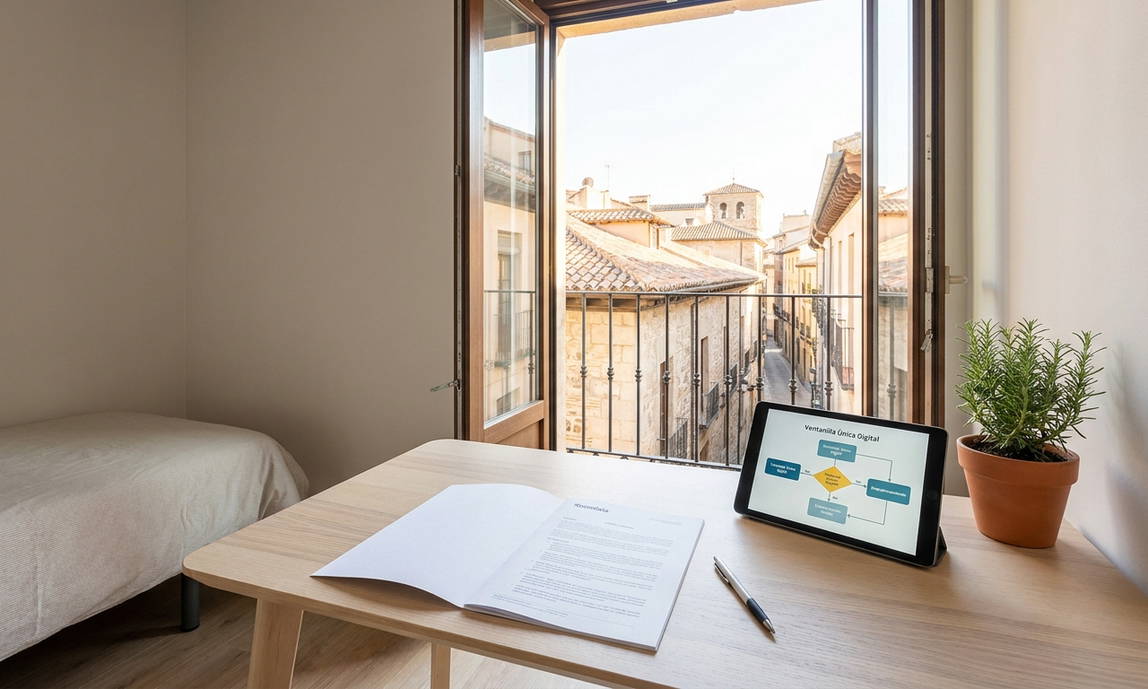
As the 2026-2027 academic year approaches, Spain is once again confirming its status as a top destination for students from all over the world. From Madrid to Barcelona, via Valencia and Seville, the influx of young international talent creates a fantastic opportunity for hosts with a spare room. At Roomlala, we know that renting a room to a foreign student in Spain is an ideal solution for generating extra income while enjoying an enriching human experience. However, the legal framework is evolving rapidly and it is essential to be well-prepared. This comprehensive guide details all the legal steps, from choosing a contract to registration formalities, so you can approach the start of the academic year with total peace of mind and in strict compliance with Spanish law.
Which contract should you choose for renting a room to a student in Spain?
The Spanish Civil Code vs. the Urban Leasing Act (LAU)
When it comes to renting a single room, Spanish legislation has a major specific feature that every host should know. Unlike renting an entire property, which is strictly governed by the Urban Leasing Act (Ley de Arrendamientos Urbanos or LAU), the room rental contract (alquiler de habitación) is historically governed by the Spanish Civil Code, specifically article 1554. At Roomlala, we would like to highlight that this legal distinction is to your advantage. It offers you much greater contractual freedom. You are not subject to the minimum rental durations or strict renewal rules imposed by the LAU. You are therefore free to set the duration of the stay, which is perfect for adapting to an international student's academic calendar, usually between 6 and 10 months.
Read also: Housing crisis: Renting a room to an apprentice, the solidarity-based solution for 2026 in French-speaking Switzerland, Shared housing in Wallonia 2026: Domiciliation and Cohabitant Status and LMNP reform and 2026 EPC rules: Why homestays are becoming the safe haven for hosts
Nevertheless, this freedom comes with responsibilities. The contract must accurately reflect the reality of the rental. It is not about artificially dividing an apartment to escape the LAU, but about renting a private space (the room) with a right of use for communal areas (kitchen, bathroom, living room). If you are renting out several rooms in the same property, each student must have their own individual contract. This clear separation protects both the host and the tenant by avoiding the joint debt liability that sometimes exists in traditional joint leases.
Practical example: Let's take the case of Javier, a host in Valencia. He wishes to rent two rooms in his apartment to international students for the academic year. Using the Civil Code, Javier writes two separate contracts running from 1 September to 30 June. If one of the students decides to leave their course in February, Javier can re-let the empty room without the second student having to cover the missing rent, thus guaranteeing secure and hassle-free management.
Drawing up a 2026 room rental contract in due form
For the coming academic year, having a solid 2026 room rental contract is your best insurance. Even if the Civil Code is flexible, a written and detailed contract is essential to prevent any disputes. At Roomlala, we advise you to systematically include the following elements to protect your interests and reassure your young international tenant.
Here are the essential clauses to include in your document:
- Precise identification of the room: Describe the rented room (surface area, furniture provided, door number if applicable) and list the communal areas the student has access to.
- Exact duration: Specify the start and end dates. For a student, it is wise to link the duration to the academic year.
- Rent and utility costs: Indicate whether utilities (water, electricity, internet) are included in the flat rate or if they are billed separately on a pro-rata basis.
- Rules of communal living: Mention quiet hours, rules regarding guests, or smoking bans.
Use case: Maria, who is hosting a French student in Madrid, has included a specific clause regarding utility costs. Her contract stipulates a rent of 400 euros, including a 50-euro provision for utilities. An adjustment is planned at the end of the semester upon presentation of invoices. This transparency helped build an immediate relationship of trust with her student, while protecting Maria against unforeseen increases in energy costs.
The essential Empadronamiento: Your obligations as a host
Why does the student need to register?
Upon arrival in Spain, the international student faces a crucial administrative step: the empadronamiento. This is the registration in the municipal register (the Padrón) which certifies their usual place of residence. For a foreign student, this step is not optional; it is strictly mandatory. Without this essential document, it will be impossible for them to obtain their foreign identity card (TIE - Tarjeta de Identidad de Extranjero), validate their student visa, open a Spanish bank account, or even take out local health insurance.
At Roomlala, we often notice that some hosts hesitate to authorise the empadronamiento for fear of tax or administrative repercussions. It is imperative to dispel this myth: authorising a tenant to register has no negative tax implications for the host. On the contrary, the Spanish government considers the refusal of empadronamiento to be an abusive practice. Refusing this step blocks the student in all their immigration and integration procedures, which can lead to serious disputes.
Practical example: Lucas, a Brazilian student arriving in Seville, rented a room for 9 months. To validate his long-term student visa, the immigration police require his certificate of empadronamiento. By denying him this right, his host would risk not only losing his tenant, who would be forced to move, but also exposing himself to sanctions for hindering the legal procedures of a foreign resident.
How to facilitate the empadronamiento in shared housing?
The procedure to facilitate this step is fortunately very simple for the host. For the student to be able to register at the town hall, you must provide them with a valid proof of address. The empadronamiento request in shared housing is one of the most common among students preparing for their arrival.
In practical terms, you have two options:
- Provide the rental contract: If the room rental contract is in their name, signed by both parties, and clearly specifies the property address, the student can go to the town hall alone with this document and their passport.
- Provide written authorisation: If the contract is not sufficient for the local town hall or if you are hosting the student free of charge, you must write a signed authorisation (Autorización de empadronamiento), accompanied by a photocopy of your identity document (DNI/NIE) and proof of ownership (title deed or a recent electricity bill in your name).
Use case: In Bilbao, Carlos rents three rooms to three different international students. To simplify the procedures for the start of the academic year, he has prepared Welcome Packs containing a copy of the signed contract and a photocopy of his DNI. Thus, from their first week, his tenants were able to make an appointment at the Ayuntamiento and finalise their empadronamiento without having to ask him again, saving precious time.
Taxation and new legal developments for the academic year in Spain for hosts
Tax advantages of long-term student rentals (IRPF)
Welcoming an international student is not only a great human adventure; it is also a financially advantageous operation, especially if you master Spanish taxation. The start of the academic year in Spain is the ideal time for a host to optimise their income. The Spanish Tax Agency (Hacienda) encourages the rental of properties as a primary residence.
As a host, you must declare the rental income from the room in your income tax return (IRPF). The good news is that you can deduct all expenses related to this rental (loan interest, IBI, co-ownership fees, insurance, property depreciation) pro-rated to the rented surface area. Furthermore, if the room constitutes the student's primary residence during the academic year (usually proven by the duration of the contract and the empadronamiento), you can benefit from a significant tax reduction on the net yield, which can reach 50% or more depending on recent reforms. Please note, however, that this reduction does not apply to short-term tourist rentals.
Practical example: Elena rents a room to a German student in Granada for 300 euros per month for 10 months. Out of her 3000 euros of annual income, she deducts 500 euros of proportional expenses (electricity, internet, IBI). On the net profit of 2500 euros, she applies the 50% reduction because it is the student's primary residence. She will therefore only be taxed on 1250 euros, greatly optimising her profitability.
The new State Single Register (Ventanilla Única Digital)
It is crucial to anticipate legal changes to remain in compliance. For the 2025-2026 period, the Spanish government is deploying a major system: the Ventanilla Única Digital (Digital One-Stop Shop). This national register aims to centralise and control short-term rentals and room rentals, in order to combat fraud and the underground economy.
In practical terms, as a host renting out a room, you will have the obligation to register your rental contract on this digital platform before the student's arrival. This system will generate a unique registration number that must appear on the contract and on the listings published on platforms like Roomlala. This register will allow the authorities to verify that safety and habitability standards are met, and will facilitate data cross-referencing with the tax authorities.
Use case: Roberto, a host in Malaga, is preparing for the 2026 academic year. As soon as the Ventanilla Única portal opens, he creates his profile and registers the features of his room to let. He obtains his registration number in a few clicks. By displaying this number on his Roomlala listing, he immediately reassures international students and their parents about the seriousness and legality of his offer, thus standing out from undeclared competition.
Avoiding traps: Risks of reclassification and regional specifics
The Housing Law (Ley de Vivienda) and rent caps
The recent Housing Law (Ley de Vivienda) has profoundly changed the Spanish property landscape by introducing the concept of stressed areas (Zonas Tensionadas) where rents for entire properties are capped. Faced with these restrictions, some hosts were tempted to transform their apartments into room rentals, taking advantage of the fact that the Civil Code does not cap room rents.
However, at Roomlala, we warn you against the risk of reclassification. The Spanish government and local authorities have strengthened controls. If an inspection shows that a host has divided their property into several rooms with the sole purpose of bypassing the LAU and rent caps (for example, by renting all rooms simultaneously without offering genuine shared services or by imposing fraudulent contracts), room contracts can be reclassified as standard leases subject to the LAU. The host then faces heavy fines and the obligation to refund overpayments.
Practical example: A host in Palma de Mallorca divided his 4-bedroom apartment into 4 separate room contracts, charging for each room at a high price, significantly exceeding the legal cap of the area for an entire apartment. Following a complaint, the inspection reclassified the contracts, considering it to be a fraud against the law. The host had to adjust the rents and pay a penalty. It is therefore vital to offer fair rents that are proportionate to the room rental market.
The specific case of Catalonia and Barcelona
As Spain is a highly decentralised country, the Autonomous Communities have the power to adapt national legislation. If you are a host in Catalonia, and particularly in Barcelona, you must be extra vigilant. The Generalitat de Catalunya has implemented very strict decrees regarding room rentals.
To avoid speculation, Catalan law now stipulates that the sum of the rents of all rooms rented in the same property cannot exceed the maximum authorised rental price for the entire property, as defined by the Generalitat's price reference index. This measure aims to align the shared housing market with the limits of the traditional market.
Use case: Marc owns an apartment in Barcelona for which the maximum reference rent is set at 1200 euros per month. He decides to rent three rooms to international students. According to Catalan legislation, the sum of the three rents must not exceed 1200 euros. Marc therefore sets the rent for the large room at 450 euros, and that of the other two at 375 euros each. By scrupulously respecting this rule, Marc ensures legal profitability and avoids the severe sanctions provided for by the Barcelona city council.
In conclusion, welcoming an international student to Spain for the 2026 academic year is a fantastic project that combines profitability and cultural exchange. By understanding the nuances between the Civil Code and the LAU, by facilitating your tenants' empadronamiento, and by anticipating new obligations such as the Ventanilla Única Digital, you ensure a smooth experience. At Roomlala, we are by your side to support you in publishing your listings and securing your bookings. Prepare your contracts now and open your doors to the world!





There are no comments yet.
Leave a comment
You must be logged in to post a comment.