
 SEARCH
 LIST YOUR PROPERTY
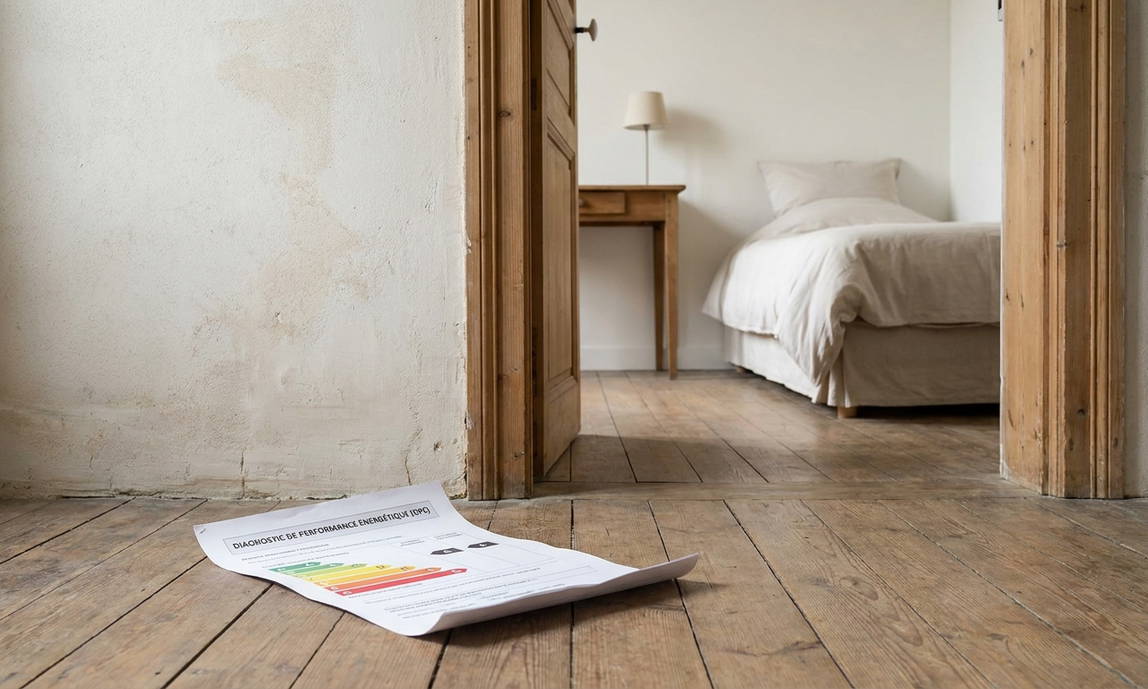
For several years, the French property market has been going through a period of profound change, driven by the government's determination to eradicate energy-inefficient housing. With the tightening of environmental regulations, many landlords are feeling overwhelmed by the approaching 2026 ban on renting out thermal sieves for certain categories of property. At Roomlala, we receive daily messages from worried hosts: are they still allowed to rent out a room in their house if it is poorly insulated? The short answer is yes, but under very specific conditions. This article aims to decode current legislation and explain in detail how the Energy Performance Certificate (DPE) for a homestay works. You will discover that renting a room within your primary residence benefits from certain legal flexibility, offering an extremely profitable alternative for hosts while providing an essential, supportive solution in the face of the housing crisis currently affecting the country.
1. The 2026 thermal sieve rental ban: What applies to a homestay
To fully understand the current situation, it is essential to revisit the foundations of the Climate and Resilience Law. This major piece of legislation introduced a particularly strict timetable aimed at removing the most energy-intensive properties from the rental market. At Roomlala, we want to reassure you: although these rules are firm, they apply with significant nuances when it comes to renting out part of your own primary residence. Hosts are not being left behind, but they must strictly master the rules of the game to avoid any disputes with their tenants.
Read also: Rising rental costs in Switzerland (Winter 2026): Renting out a room to balance your budget, Shortage of student accommodation in Belgium in 2026: Homestay, the supportive alternative and Youth Rental Voucher autumn 2026: How to finance your shared housing in Spain
1.1. The strict timetable of the Climate and Resilience Law
Since 1 January 2025, the law has been clear: properties classified as G in the Energy Performance Certificate (DPE) are formally prohibited from being rented out if they constitute the tenant's primary residence. This drastic measure aims to protect tenants from energy poverty. However, this is only the first step, as this ban will inexorably extend to class F from 1 January 2028. If you are considering renting out a room, given the 2026 legislation, you must be aware that these bans also apply to a homestay as soon as the signed lease makes this room the tenant's primary residence. This typically concerns a 9-month student lease or a standard one-year renewable furnished lease. In these scenarios, the rented room must meet the same energy decency criteria as an apartment or an entire house.
1.2. A reassuring pooling of the DPE for landlords
This is where the first piece of good news comes in for you, dear hosts. If you rent out a room located inside your house or apartment, you absolutely do not need to have an exclusive DPE carried out for this single room. The law allows for the pooling of the diagnostic. In practical terms, it is the overall DPE of your primary residence that is valid and must be annexed to the rental agreement. This saves you from complex administrative procedures and unnecessary additional costs. The energy performance of the room is therefore assessed in light of the overall performance of your home, taking into account the general insulation, the central heating system, and the ventilation of the entire building.
Practical example: Let's take the case of Martine, a pensioner living in Lyon. She owns a large apartment with an overall DPE rating of E. She wishes to rent out a north-facing room, which, if evaluated on its own, might perhaps verge on class F. Thanks to the pooling of the diagnostic, Martine can use the overall E-class DPE of her apartment. She was thus able to sign a 9-month student lease legally via Roomlala, without fearing the 2026 thermal sieve rental ban, while offering affordable accommodation to a young student.
2. Exceptions and flexibility for renting a room in 2026
While long-term rental is subject to strict rules, legislation offers some breathing room and very interesting alternatives for owners of thermally inefficient properties. At Roomlala, we always encourage our hosts to explore all legal options to continue generating additional income while respecting the legal framework. The year 2026 actually brings its own share of regulatory changes that could well save the day for many hosts.
2.1. Short-term rental: a legal loophole
The main loophole, or rather the major legal exception to the ban on renting out thermal sieves, lies in the nature of the lease. Indeed, the ban on renting out properties classified as G (and soon F) only targets primary residence leases at the national level. Consequently, if you rent out your room for short stays to tourists, professionals on business, or seasonal workers (without it becoming their primary residence), you are not subject to this rental ban. This flexibility allows owners of poorly rated properties to maintain a rental business and receive income while gathering the funds needed to undertake energy renovation work at their own pace.
2.2. The new 2026 DPE calculation: a boon for electric heating
The other huge piece of news that is bringing a smile back to landlords is the adjustment of the DPE calculation scheduled for 2026. The government has approved the modification of the electricity conversion coefficient, which will go from 2.3 to 1.9. What does this mean for you in concrete terms? Until now, properties heated by electricity were heavily penalised by the DPE calculation method, often relegating them to classes F or G despite having decent insulation. With this new, more favourable coefficient, a great many properties will automatically see their rating improve by one or two letters, without the owner having to carry out any renovation work. It is a real breath of fresh air for the rental market.
Practical example: Julien owns a house in Brittany heated exclusively by modern electric radiators. His current DPE classifies it as G, which prevented him from renting a room to a student annually since 2025. Thanks to the new DPE calculation effective in 2026, Julien's house automatically moves to class E. He can now generate a new, updated DPE and put his room back on Roomlala for a long-term student lease, completely legally and without having spent thousands of pounds on insulation.
3. Legal risks and points of vigilance for hosts
Although renting out a room as a homestay offers undeniable advantages, it is our duty at Roomlala to warn you about certain traps to avoid. The law is protective of tenants, and any attempt to circumvent the rules can backfire on the landlord. It is crucial to clearly understand the boundary between a homestay and a self-contained unit so as not to lose the benefits of this particular status.
3.1. The rent freeze still in force
It is fundamental to remember that even if you find a solution to rent out your room, a major financial restriction remains. Since the summer of 2022, the ban on increasing the rent for properties classified as F and G has been strictly in force throughout the French territory. And beware, this measure applies fully to renting a room as a homestay if it is the subject of a long-term lease (primary residence). You will therefore not be able to apply an annual indexation to the rent, nor increase it when changing tenants, until work has been carried out to remove the property from the thermal sieve status.
3.2. The risk of reclassification as a self-contained unit
This is undoubtedly the most critical point of vigilance for hosts. For your rental to be legally considered a 'homestay', the tenant must necessarily share certain living areas with you (generally the kitchen, toilets, or bathroom). If the room you are renting has a totally independent entrance from the outside and is equipped with its own sanitary facilities and a kitchenette area without any access to the common areas of your house, the courts may reclassify it as a 'self-contained unit' (a studio or an outbuilding). In this case, you lose all the flexibility associated with a homestay, and the property will be subject to the strict rules of standard apartments, requiring its own individual DPE.
Practical example: Sophie converted the basement of her class G house into a small studio with an entrance door leading to the garden, a kitchenette, and a shower. She thought she could rent it out under the 'homestay' status to bypass the individual DPE requirement. Unfortunately, her tenant took legal action. The judge reclassified the space as a self-contained unit. Sophie found herself in an illegal situation (renting out a G-rated thermal sieve as a primary residence) and was ordered to suspend the rent and carry out renovation work. At Roomlala, we advise you to maintain genuine sharing of space to secure your status.
4. Our Roomlala tips for renting with complete peace of mind
Faced with this legislative maze, the Roomlala team is here to support you and help you make the most of your available space. The first step is to correctly assess your current DPE and anticipate the new 2026 calculation. If you are currently in class G or F, do not panic. You can easily adapt your rental strategy by prioritising short or medium-term rentals (tourism, short internships of less than 8 months) for which the concept of a primary residence does not apply. Our platform allows you to easily adjust the length of your stays to target professionals or holidaymakers.
Next, we highly recommend taking advantage of state grants to consider energy renovation work in the medium term. Schemes like MaPrimeRénov' can be combined and can finance a large part of the insulation for your loft or the replacement of your windows. Not only will you enhance the value of your property, but you will also offer optimal comfort to your tenants, which will justify an attractive rent and ensure host loyalty. Don't forget that a well-insulated room also means lower energy bills for yourself on a daily basis.
Finally, be transparent in your listings on Roomlala. Clearly indicate shared spaces and the lifestyle within your home. Trust is the key to successful cohabitation. By scrupulously respecting the legal framework of the homestay DPE and avoiding the trap of reclassification as a self-contained unit, you will continue to enjoy this wonderful human and financial adventure that is homestay rental. We are proud to count you among our community of committed hosts, who offer a concrete and convivial response to the housing challenges in France every day.
There are no comments yet.
Leave a comment
You must be logged in to post a comment.