
 SEARCH
 LIST YOUR PROPERTY
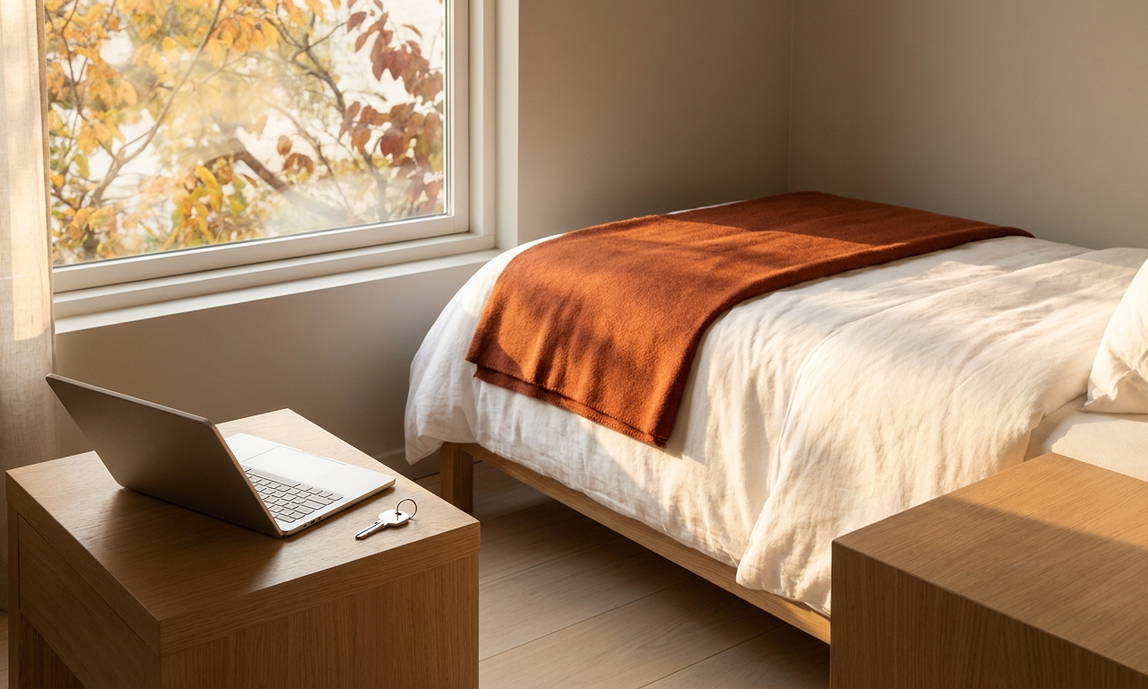
Autumn is here, and with it comes the traditional flurry of budget debates in Parliament. This year, discussions surrounding the 2027 Finance Bill (Projet de Loi de Finances) are raising many questions for hosts. The 2027 Finance Bill and homestays is at the heart of concerns for those renting out part of their main residence. At Roomlala, we know how complex and stressful tax matters can seem. That is why we have decided to break down what this 2027 budget means for you. Our goal? To reassure you, inform you about the continuation of current tax exemptions, and support you in your rental plans. As parliamentarians debate, discover everything you need to know to continue renting out your spare room with peace of mind and optimise your additional income.
Understanding the 2027 Finance Bill's impact on homestays
The 2027 Finance Bill, presented at the end of September 2026, represents a decisive deadline for French tax policy. For hosts, autumn announcements are often synonymous with uncertainty, especially regarding property tax. The search for 2027 Finance Bill and homestays is on everyone's lips, as parliamentary debates must rule on the extension of certain historical tax benefits. However, it is essential to distinguish between media buzz and the reality of the legislation currently under discussion.
Read also: 2026 Housing Law: What changes for room rentals in Spain, 2026 property tax: How renting out a room in your homestay can help reduce the bill and Mobility Lease 2026: The ideal solution for renting a room to students and temporary workers
It is true that an information report from the National Assembly (report no. 3056 published in July 2026) stirred things up by suggesting a tightening of the overall taxation of furnished rentals. Parliamentarians specifically pointed to the status of the Non-Professional Furnished Lessor (LMNP) and its real-term depreciation regime, which is sometimes considered too advantageous compared to unfurnished rentals. Nevertheless, at Roomlala, we want to reassure you: the social exemption linked to renting out a spare room in your home is absolutely not the primary target of these reform proposals. Public authorities make a very clear distinction between pure rental investment and the collaborative approach of opening your own doors.
In this context, the debate surrounding the 2027 Finance Bill should be followed with attention, but without rushing. The measure that allows you to be exempt from tax on rent received (governed by Article 35 bis of the General Tax Code) is a provision with a social purpose. It aims to mitigate the housing crisis by encouraging the optimisation of existing space. It is therefore highly unlikely that the government will decide to abruptly eliminate this scheme, especially as it promotes housing for students and seasonal workers, two particularly vulnerable groups in the current property market.
The expected continuation of the tax exemption
Historically, Article 35 bis of the CGI has always been extended for a few years during previous budget debates. The challenge of the 2027 Finance Bill is to extend this guarantee beyond its current end date, set for 31 December 2026. The signals sent by the public authorities are rather reassuring. The homestay tax exemption is seen as an effective tool to combat the housing shortage without requiring expensive new construction. We therefore invite you to remain confident about the longevity of this tax benefit, while keeping an eye on the final vote on the finance bill, which will take place at the end of the year.
Why you shouldn't panic over the announcements
Every autumn, amendment proposals multiply in Parliament, sometimes creating an anxious climate for hosts. It is crucial to understand that the majority of these amendments will never be adopted. At Roomlala, we advise you not to change your rental plans based on mere rumours or isolated proposals. The taxation of renting out part of your main residence is based on solid foundations. Continue to host your tenants with peace of mind, because until proven otherwise, the legal framework that protects and benefits you remains fully in force.
2026 long-term rental taxation: A reminder of the rules in force
While waiting for the 2027 Finance Bill to be definitively voted on and enacted, it is essential to master 2026 long-term rental taxation. The good news is that the income tax exemption for renting or sub-letting part of your main residence is already guaranteed until 31 December 2026. This legal security allows you to plan your rentals for the coming year without fearing an unexpected tax adjustment. However, to benefit from this tax windfall, it is not enough just to rent out a room: you must scrupulously comply with a set of criteria defined by the tax authorities.
The first fundamental criterion concerns the nature of the room rented and the use your tenant makes of it. For the exemption to apply, the room must constitute the tenant's main residence. There is, however, a notable and very useful exception: the room can also constitute the tenant's temporary residence if they can justify a seasonal employment contract. At Roomlala, we see many hosts take advantage of this flexibility to welcome agricultural workers in the summer or ski resort staff in the winter, all while retaining their tax benefit. Furthermore, the rented room must be adequately furnished, offering the tenant all the necessary comfort for daily living (bed, bedding, storage furniture, lighting, etc.).
The second criterion, and arguably the one most monitored by the tax authorities, concerns the amount of rent applied. The law requires that the rent be set within so-called "reasonable" limits. Each year, the tax authorities publish an update to these tolerance thresholds via the Official Bulletin of Public Finance (BOFiP). For the year 2026, these ceilings have been re-evaluated to take into account inflation and the evolution of the property market. It is your responsibility to ensure that the rent you charge does not exceed these maximum amounts, otherwise you risk losing the entire exemption.
Conditions to benefit from the homestay tax exemption
To sum up, the homestay tax exemption rests on an essential triptych. Firstly, the room(s) rented must be an integral part of your own main residence. You cannot apply this scheme to a second home or an outbuilding completely detached from your dwelling. Secondly, the rental must meet the tenant's need for a main (or seasonal) residence. Finally, the rental price must remain below the legal ceilings. If you tick these three boxes, the income generated by this rental does not even need to be declared on your annual tax return!
2026 rental income tax ceiling: Key figures to respect
The 2026 rental income tax ceiling has been officially communicated and it is essential to remember it. For income received in 2026, the annual rent ceiling excluding charges amounts to €215 per square metre of living area in the Île-de-France region, and €159 per square metre in other French regions. Let's take a concrete example: if you live in Bordeaux (outside Île-de-France) and rent out a 12 m² room, your annual rent excluding charges must not exceed €1,908 (i.e. 12 x €159), which corresponds to a maximum monthly rent of €159 excluding charges. If you are in central Paris and rent out a 15 m² room, the annual ceiling will be €3,225 (i.e. 15 x €215), or approximately €268.75 per month excluding charges.
The pitfalls to avoid to secure your rental income
While the Article 35 bis CGI scheme is particularly attractive, it also contains strict rules that do not allow for any approximation. At Roomlala, we support hosts daily, and we notice that some errors occur frequently. The first error is incorrectly assessing the living area of the rented room. Only the area of the private room (and possibly bathrooms if they are exclusively reserved for the tenant) with a ceiling height of at least 1.80 metres should be taken into account. Do not include common areas (living room, shared kitchen) in your rent ceiling calculation, as the tax authorities do not tolerate them in this specific calculation.
Another major point of vigilance concerns the clear separation between rent and charges. The ceilings of €215 and €159 per square metre are strictly excluding charges. It is therefore imperative, when drafting your rental agreement on our platform, to clearly distinguish between the amount of the main rent and the fixed rate (or provision) for charges (water, electricity, internet, etc.). If you offer a "bills included" rent without specifying, the tax authorities could consider that the entire amount corresponds to the rent, which would automatically cause you to exceed the authorised ceiling.
Finally, it is vital to keep all evidence of your rental's compliance. Carefully keep a copy of the lease (easily generated via Roomlala), the rent receipts given to the tenant, as well as proof of your tenant's status (school certificate for a student, employment contract for a seasonal worker). In the event of a tax audit, these documents will be your best allies to prove that you are strictly respecting the conditions of the exemption and that you are a host in good faith.
Exceeding the ceiling: a major tax risk
Compliance with the ceilings is of absolute rigour. It must be clearly understood that there is no room for error or marginal tolerance. Exceeding it, even by just a few euros over the year, leads to a devastating consequence: the taxation of all rent collected from the very first euro, and not just the excess portion. For example, if your annual ceiling is €1,908 and you receive €1,950 in rent excluding charges, the entire €1,950 must be declared in the Industrial and Commercial Profits (BIC) category and will be subject to income tax as well as social security contributions.
Do not confuse long-term rental with a tourist guest room
It is essential not to confuse long-term rental (which is the subject of this article) with the rental of guest rooms intended for passing tourist clientele. The tax rules are radically different. For guest rooms, a tax exemption also exists, but its ceiling is extremely low: it is limited to only €760 per year (including rent and ancillary services like breakfast). If you rent your room to tourists for a few nights via short-term platforms, you will reach this ceiling in just a few weeks. Choosing long-term rental with Roomlala is therefore the safest and most profitable strategy to provide tax relief on your rental income over the long term.
Why take the plunge into long-term rental with Roomlala today?
Faced with economic uncertainties and the debates surrounding the 2027 Finance Bill, renting out a spare room remains an exceptional safe haven. It is one of the few tax schemes that combines immediate profitability, legal security (at least until 2026), and social utility. By choosing to rent out an unused room in your home, you create a source of tax-free additional income, ideal for dealing with inflation, paying your energy bills, or financing your personal projects. But beyond the financial aspect, it is also a wonderful human adventure.
At Roomlala, we firmly believe that intergenerational cohabitation and homestays are the solutions of the future for the housing crisis hitting France. By opening your doors, you enable a student to pursue their studies in good conditions, or a young professional to start their career without being strangled by exorbitant rents. You actively participate in a sharing economy that is socially responsible. And for this experience to be a complete success, our platform is designed to simplify your life at every stage of your rental project.
We know that starting to rent out can raise fears: fear of non-payment, apprehension about choosing a tenant, administrative complexity... That is where our expertise comes into play. By publishing your listing on Roomlala, you join a community of trust. You benefit from secure tools to communicate with candidates, verify their profiles, and sign your contracts legally. Do not let the political debates of the autumn slow down your plans. The current legal framework is extremely favourable to you, so don't wait any longer to take advantage of it.
A concrete response to the housing crisis
- Strong social impact: You concretely help students, interns, or seasonal workers to find decent housing.
- Space optimisation: You give a new lease of life to a room that has been empty since your children left or following a life change.
- Social connection: You break loneliness and create enriching exchanges with people from all walks of life.
Security and simplicity with Roomlala
- Maximum visibility: Your listing reaches thousands of qualified tenants looking for long-term accommodation.
- Secure payments: Our system guarantees the payment of your rent, thus protecting you against the risks of non-payment.
- Legal support: We provide you with lease templates compliant with current legislation, incorporating the specificities of homestays.
- Dedicated customer service: Our team is at your disposal to answer all your questions, whether they are fiscal or practical.




There are no comments yet.
Leave a comment
You must be logged in to post a comment.