
 SEARCH
 LIST YOUR PROPERTY
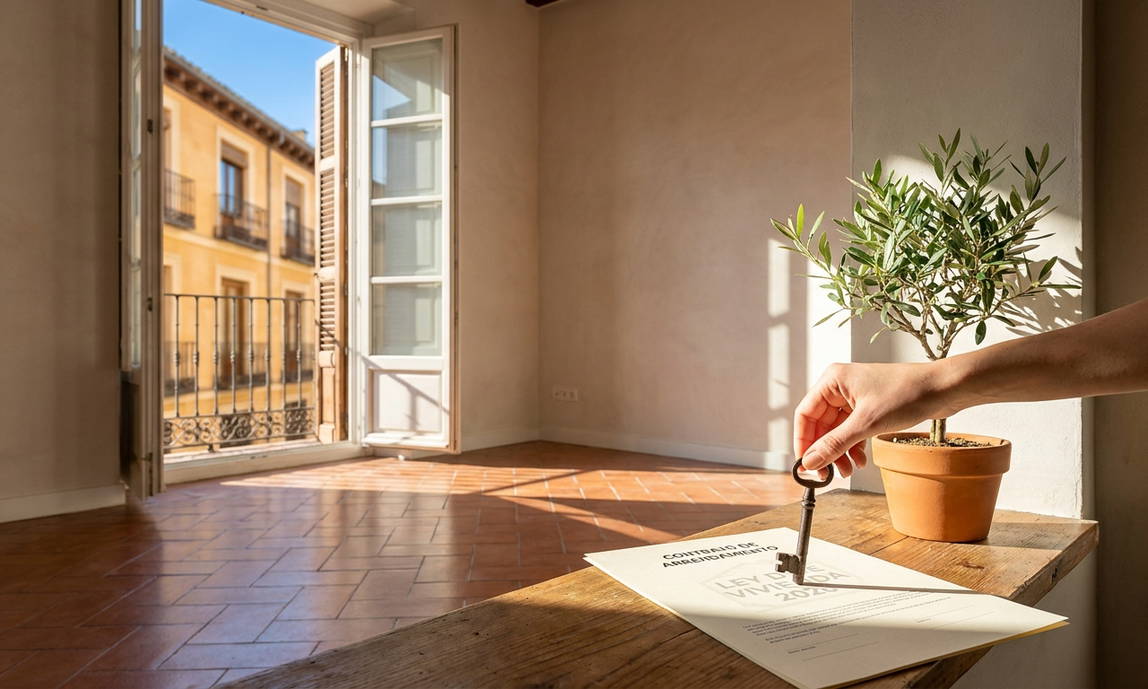
Since the adoption of the controversial Housing Law (Ley de Vivienda), the Spanish property market has seen the proliferation of a particularly worrying practice: the surge in "alquileres de temporada" (short-term lets). Used extensively to bypass rent controls, these short-term contracts have made life precarious for many tenants. But in this year of 2026, the legal landscape has changed radically. The Spanish government and regional authorities have decided to put an end to the shenanigans of fraudsters.
At Roomlala, we follow these legal developments very closely to ensure you have a secure and peaceful rental experience. If you are a host renting out a room, or a young professional looking for a homestay in Spain, these new regulations have changed the rules of the game. Here is a breakdown of an unprecedented legal offensive that is restoring prestige and stability to traditional long-term shared housing.
Read also: Porta 65 Jovem 2026: The complete guide to funding your shared housing in Portugal, Rent control in 2026: What are the new rules for shared housing? and 2026 rental reference rate in Switzerland: Shared housing to counter the rise
The end of impunity for fake short-term lets in 2026
A redefinition based on purpose rather than duration
For years, the trick was simple: you only had to get an 11-month lease signed for the contract to be considered "seasonal" or "short-term", thus avoiding the constraints of the standard Urban Leases Act (LAU). Since 1 January 2026, those days are over, particularly with the entry into force of the Catalan Law 11/2025, which is a pioneer in Spain.
From now on, Spanish legislation redefines a short-term lease by its purpose and no longer by its duration. This means that an 11-month contract is no longer automatically a short-term lease. The host has a strict legal obligation to prove the real, justified, and documented cause for their tenant's stay.
Whether it is university enrolment, a fixed-term employment contract, or a specific medical treatment, the "causalidad" (the reason) must be attached to the rental contract. Without this irrefutable proof, the contract is automatically considered a principal residence lease, with all the protective rights that this entails for the tenant.
Concrete example: Maria, a Master's student at the Complutense University of Madrid, signs a 9-month lease. The host must attach Maria's certificate of enrolment to the contract. If they rent this same apartment for 9 months to a young professional on a permanent contract in Madrid without a justification for the short-term nature, the contract is illegal in its temporary form.
Deterrent financial and legal sanctions
The authorities have understood that to make fraudsters comply, they had to hit them where it hurts: the wallet. The fraudulent use of a short-term lease to circumvent the Housing Law is no longer a simple administrative irregularity; it is a severely punished offence that leads to immediate and long-lasting consequences for the landlord.
The first sanction is the immediate reclassification of the contract. If a judge or a housing inspector finds that the short-term lease is unjustified, it is automatically converted into a standard residential lease. The landlord then finds themselves committed for a legal period of 5 years (or 7 years if it is a legal entity), with no possibility of evicting the tenant at the end of the initial 11 months.
Added to this reclassification are staggering fines. Regions that have declared "stressed areas" apply exemplary sanctions. In Barcelona, for example, fines for short-term lease fraud can now reach the colossal amount of 90,000 euros, enough to dissuade landlords with multiple properties from playing with the law.
Use case: A Barcelona landlord rented their apartment with a fake 11-month lease to a couple of employees on permanent contracts to avoid rent caps. Reported by their tenants, they saw the contract reclassified as a 5-year lease with rent lowered to the level of the reference index, and received a 45,000 euro fine for a serious breach of the housing law.
Rent capping and market ruses: what to watch out for
The alignment of room rentals with standard leases
Until recently, renting by the room (very popular in shared housing) escaped the rent caps imposed by the Housing Law. Many investors bought family apartments to divide them and rent each room individually at a high price. The 2026 Catalan law has spectacularly plugged this loophole.
In Catalonia, justified short-term lets and room rentals located in stressed areas are now subject to the same rent caps as standard residential leases. The sum of the rents for each room can no longer exceed the maximum rent authorised for the entire property according to the official reference index.
This measure aims to stop speculation on shared housing, which made access to housing impossible for students and young workers. At Roomlala, we welcome this clarity, which allows honest hosts to offer fair rates while protecting the purchasing power of tenants.
Concrete example: Take a 4-bedroom apartment in the Gràcia neighbourhood of Barcelona. If the reference index sets the maximum rent for this apartment at €1,200 per month, the host can no longer rent each room at €500 (i.e., €2,000 in total). The sum of the four rents must be limited to €1,200, or €300 per room.
Beware of "recreational and leisure" clauses
As always when faced with new legal constraints, the property market tries to find loopholes. The new trick identified in 2026 concerns the reason for the stay. Since study or work reasons are now regulated and capped, some unscrupulous landlords are turning to the only reason still exempt from rent control: leisure use.
We are seeing the appearance of clauses stipulating that the property is rented for exclusively "recreational, cultural, or leisure" use. Landlords are thus trying to pass off medium-term rentals as secondary residences or extended tourist stays, hoping to set the rent freely.
However, this practice is extremely risky. The courts apply the theory of "fraud on the law". If the tenant proves that they use the property to live in on a daily basis (going to work, receiving mail, sleeping there most of the year), the recreational clause will be judged null and void.
Practical advice: If you are a tenant and a landlord asks you to sign a lease mentioning "recreational" use when you are coming to work or study, run away or sign knowing that you will be able to easily challenge this contract before the local authorities to have it reclassified.
The legal bombshell of May 2026: the cancellation of the national register
The year 2026 was also marked by a real legal earthquake. In May 2026, the Spanish Supreme Court made a historic decision by cancelling the Single Register of Short-Term Leases (NRUA) and the Digital One-Stop Shop that the central government had just set up.
The country's highest court justified this cancellation by invoking an invasion of regional powers (competencias autonómicas). In Spain, housing is a decentralised competence. The Court considered that the central state could not impose a single national register without encroaching on the regulatory power of the Autonomous Communities.
This cancellation now creates a strong legal asymmetry across the country. The fight against short-term lease fraud now relies almost exclusively on regional regulations and inspections. Thus, regions like Catalonia have an extremely strict legal and repressive arsenal, while other regions (such as Madrid or Andalusia) rely on much less systematic checks.
For hosts and tenants, this implies increased vigilance: it is essential to find out about the specific laws of your Autonomous Community. What is severely punished in Barcelona may be subject to a relative legal vacuum in Valencia or Seville, although national jurisprudence tends to toughen up everywhere against abuse.
Why traditional long-term shared housing is the safest solution
Faced with the increase in checks, the legal uncertainty of unjustified short-term leases, and the risk of colossal fines, the market is returning to basics. Traditional long-term shared housing is now emerging as the most stable, most profitable in the long term, and most legally secure model.
For hosts, abandoning risky legal setups has multiple advantages:
- Total legal security: A standard residential lease fully respects the LAU. No risk of reclassification, fines, or endless litigation with tenants.
- Financial stability: No more rental vacancy between two 11-month leases. Long-term tenants (often young professionals) stay for several years, ensuring regular and predictable income.
- Less management: The constant turnover of temporary tenants requires time, agency fees, and frequent refurbishment. Long-term lets encourage the maintenance of the property by tenants who feel at home there.
At Roomlala, we strongly encourage this model. Our platform facilitates connections between trusted hosts and tenants (students, young professionals) looking for a real home. By favouring homestays and long-term shared housing, you contribute to a healthier and more humane property market.
Use case: Carlos, who owns a large apartment in Valencia, had long been chaining 11-month leases with international students. Tired of the constant changes and frightened by the new 2026 laws, he decided to rent his rooms as long-term shared housing via Roomlala to young professionals. Not only has he secured his income for 5 years, but he has also regained invaluable peace of mind, far from the threats of regional inspections.
In conclusion, the year 2026 marks a decisive turning point in Spain. The end of the El Dorado of fake short-term leases is excellent news for the stability of the market. Whether you are a tenant or a host, choosing transparency and long-term lets is now the wisest and most serene choice.





There are no comments yet.
Leave a comment
You must be logged in to post a comment.